✧✦A LITTLE CURIOSITY GOES A LONG WAY
ReadyWhy Did My Sleep Change?
A grown-up resource for questions about sleep in perimenopause, menopause, and midlife.
General educationExplore this resource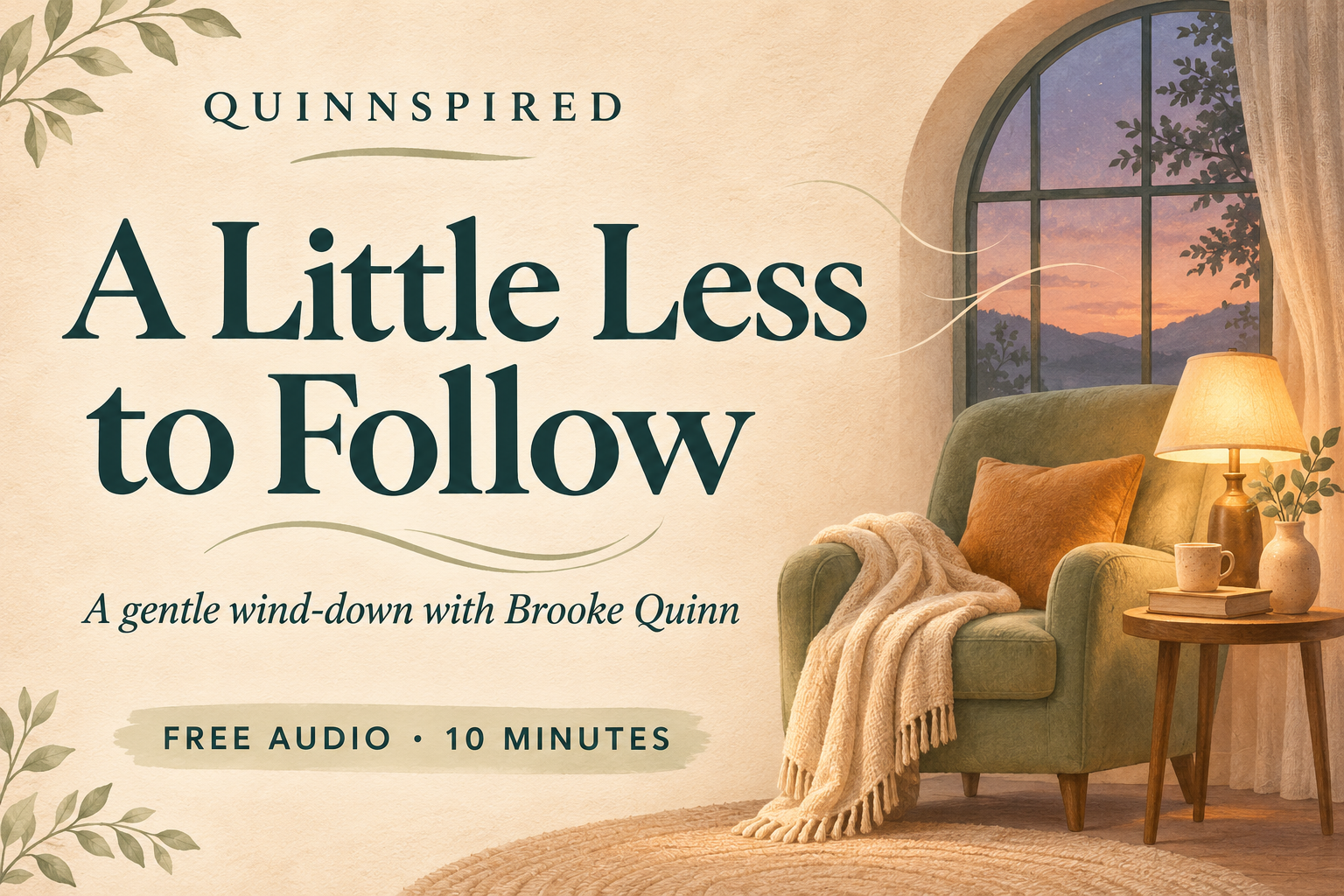
Audio · Adults
A gentle voice to follow when your thoughts are still moving. No pressure to clear your mind or fall asleep.
10 minutes, 14 seconds. Voice only, no music. An optional relaxation resource, not a clinically tested sleep treatment. Listen only somewhere you can safely rest; never while driving.
You can keep your eyes open, move, pause, or stop. There is no sequence to get right.
10:14 · Brooke Quinn · Voice only · No music
Open or save the MP3Listen somewhere you can safely rest. Never while driving or doing something that needs your attention. The full transcript is available below if you prefer to read.
FROM BROOKE’S ORIGINAL INTRODUCTION
A free, 10-minute wind-down with Brooke Quinn. For evenings when the day has ended but your thoughts are still moving.
You don’t have to clear your mind, breathe a certain way, or fall asleep before it ends. There’s simply a voice to follow, with room to move, pause, or stop.
A friend asked whether I would record something she could listen to at bedtime. That small request became this first Quinnspired wind-down.
I bring an MSc in Sleep Medicine from the University of Oxford, a background as a Registered Polysomnographic Technologist, and my own experience of difficult sleep and sensory sensitivities. I wanted to make something simple enough to use on a tired evening.
The recording returns to one ordinary point of contact, such as fabric beneath your hand, with my voice as an alternative if touch feels distracting. You don’t need to visualize a scene or remember a sequence. Breathing stays uncounted, and the ending gives you permission to still be awake.
These are choices in how I designed this recording, not evidence that this particular audio improves sleep. It is an optional relaxation resource and general sleep education, not clinical assessment or treatment for insomnia or another sleep disorder.
After listening, or another day if you prefer, I’d love to hear: What felt comfortable? What distracted you? Would you choose to listen again, and what would you change?
Share optional feedback. No name or email is required. Please leave out personal health details.
If sleep difficulties are persistent or affect your daytime life, speak with a qualified healthcare professional. This recording does not replace care.
Introduction from the original Quinnspired post, with its feedback link updated for this hub. This is not a transcript of the recording.
Visit the original postIf an external link won’t open in this preview, copy it and paste it into Safari or your usual browser.
Published audio · full transcript, MP3 & introduction included
Share optional feedbackREAD AT YOUR OWN PACE
Transcript supplied by Brooke Quinn. Punctuation and paragraph breaks have been tidied for reading. This is the spoken text; pauses are not timed.
It’s Brooke. Maybe the day has ended, but your mind is still moving through it. Something you meant to do. A conversation you’re still having in your head. Tomorrow, already asking for your attention. For the next few minutes, I’ll give you something simple to follow.
Listen somewhere you can safely rest, never while driving. Set the volume so you can hear me comfortably. You can move, keep your eyes open, or stop whenever you need to.
Let’s start with where you are. Adjust your pillow or settle back into your chair. Find a position that feels comfortable enough for now. You don’t have to stay in it for the whole recording. Take a moment to make that small adjustment.
Rest a hand somewhere comfortable. Notice the fabric beneath it: a sleeve, a blanket, the side of the chair. Just that small place where your hand meets something. If touch is distracting, stay with the sound of my voice instead.
There is no need to picture a different room or transport yourself somewhere else. We can begin here. The fabric under your hand, my voice in the room. One ordinary thing you can come back to without having to remember a sequence.
If you’ve been trying to hold yourself perfectly still, let yourself shift. Settle your arm somewhere it can be supported. Let your fingers rest in whatever shape feels easy.
Give the chair or bed a little more of your weight, whatever feels comfortable.
Now notice one breath, only if that feels comfortable. Let it come in. Let it go out. It can be an ordinary breath. No need to fill your lungs all the way or hold anything in.
Then leave the next breath to happen in its own time. You don’t have to match my pace. We’re giving you less to manage, including your breathing.
If noticing it makes you uncomfortable, return to my voice.
Bring your attention back to the fabric beneath your hand. It may feel exactly as it did a moment ago. That’s fine. There doesn’t have to be a new sensation. For a little while, this small familiar point of contact can be enough to notice.
A thought may have arrived while we were doing that, perhaps several. You don’t need to go back and start again. Pick up here with the next sentence.
If a thought is asking you to plan something that can wait, you can say quietly to yourself, “I can come back to that.” Just once. You don’t have to keep repeating it until you believe it. And if something genuinely needs your attention, you can pause and take care of it.
There may be things you care about that are still unfinished. Leaving them for these few minutes doesn’t mean they don’t matter. It means you’re taking a few minutes. The email can stay an email. Tomorrow’s conversation can stay tomorrow’s conversation.
You don’t have to rehearse every part of it here.
Feel the fabric underneath your hand again.
Notice its surface for a moment. Smooth, textured, warm, cool, whatever is actually there. There’s no particular feeling you’re looking for. If you’re following my voice instead, you can keep listening just as you are.
You may hear another sound in the room. It can come and go.
When you notice your attention has wandered, there’s nothing to catch up on. This recording does not have a plot you need to keep track of.
I’ll leave a little more space now. You can stay with that familiar point of contact or simply let the words pass. There’s no need to check what your mind is doing in between.
Let your hand rest. Let the surface beneath you do the supporting. Your breath can continue in its own way. There’s nothing else to add to the routine right now.
We’ll leave it here for tonight. You don’t have to gather your thoughts or come back to my voice. You can stay just as you are with the support beneath you and your breathing moving at its own pace.
If you’re still awake, that’s okay. These few minutes don’t need to end in sleep to have been time you chose for yourself. There’s nothing more to follow and nothing you need to answer.
Thank you for letting me keep you company for a little while. Good night.
STAY WITH WHAT YOU NEED
A grown-up resource for questions about sleep in perimenopause, menopause, and midlife.
General educationExplore this resource Ready
A little rhyme for winding down together. Listen, move, imagine—or simply rest.
Creative activityExplore this resource